
Criminal Court Records in Bay County
A criminal court record is the case file a court opens once a prosecutor files charges. The clerk builds and keeps it. It holds every paper and event in the case, including the complaint, the counts charged, bond, hearing dates, motions, the plea or verdict, and the sentence. The file grows as the case moves, so it reads like a running log rather than a single summary. Each hearing adds a new line. In Bay County a criminal file is one slice of the broader set of Bay County court records the courthouse maintains.
Which court holds the file depends on the charge. Felonies are handled by the 18th Circuit Court, the county's general-jurisdiction trial court. Misdemeanors, traffic misdemeanors such as drunk driving, and the preliminary examinations that test felony cases start in the 74th District Court. Both courts sit in the same downtown Bay City justice campus. The severity of the charge, not the building, sets the venue. Michigan builds its trial system around three courts, and Bay County follows that statewide structure directly.
How to Search Bay County Criminal Records
Bay County runs a public case-search portal that reaches both district and circuit results. You pick the court from a dropdown and search by name or docket number. Basic searching is open to anyone, though a few features sit behind a login. The same portal feeds the calendar view, so a hearing date and a case file can be pulled from one place.
- Open the county court case-search page hosted at courtpmt.baycounty.net.
- Enter the defendant in the Last/Business Name and First Name fields, or type a docket number in the Case Number field.
- Set the Court dropdown to the district or circuit court, and narrow by Judge or Jurist when you know the assigned judge.
- Select Display to load the result grid, then open a case to read its charges, judgment, and financial detail.
- Request a certified copy in person at the Bay County Court Facility when you need an official file.
A county portal search shows only Bay County filings. For a full statewide criminal history, Michigan keeps records through the state police, and complete case files are requested at the courthouse rather than through a county FOIA request. The charges themselves get a closer look on the court charge records page.
Stages of a Bay County Criminal Case
A criminal case moves through set stages, and each one leaves a mark in the file. Charges open the case. Arraignment reads them to the defendant. Pretrial work sorts out evidence and any plea offer. The case then ends in a plea or a trial, followed by disposition and sentencing.
Case flow: Charges Filed › Arraignment › Pretrial / Motions › Plea or Trial › Disposition › Sentencing
The county calendar search exposes many of these steps by name. Event labels include Advice of Rights Hearing, Pre-Trial Conference, To Accept or Reject, Sentencing, and Probation Violation. A reader can watch a case advance from one hearing to the next.
| Stage | What Happens |
|---|---|
| Arraignment | The defendant hears the formal charges and enters a first plea, and bond is set. In Bay County, arraignments are held at the jail on weekdays and may be viewed at the court facility. |
| Pretrial / Motions | Attorneys trade evidence, argue motions, and weigh plea offers at conferences such as the pretrial conference and the accept-or-reject hearing. |
| Plea or Trial | The case resolves by a plea, or it goes to trial, where a judge or jury decides guilt on each count. |
| Sentencing | After a plea or a guilty verdict, the court imposes jail, probation, fines, costs, and restitution, and each item posts to the file. |
What Bay County Criminal Records Show
The sample case-detail page in Bay County shows how much a single file holds. It names the parties, lists the money assessed, and breaks the case out charge by charge. Reading it well means knowing what each field carries.
| Field | What It Shows |
|---|---|
| Case Number | The unique docket number for the case, which can be searched directly. |
| Petition # | A secondary filing reference tied to some Bay County case records. |
| Parties | The defendant's name and birth year, shown in the case-search grid. |
| Charge / Count | Each count with its charge text, sometimes tagged with a city or location string. |
| Adjudication Date | The date the count was decided by the court. |
| Judgment | The outcome of the count, such as responsible, guilty, or dismissed. |
| Fines / Costs | The amount assessed, with amount paid, balance due, and the last payment date. |
| Jail Term | Confinement time recorded in years, months, and days. |
| Probation Term | Supervision time recorded in years, months, and days. |
The charge table inside a case names each count, the charge text, the adjudication date, and the judgment. Bay County sometimes appends a city to the charge, so a listing may read with a locality tag attached. The birth-year column in the result grid helps tell apart two people who share a name.
Charges vs. Convictions
Being charged is not the same as being convicted. A charge is an accusation filed by the prosecutor. A conviction is the court's finding of guilt, reached by a plea or by a verdict. A Bay County criminal court record can show counts that were later dropped, dismissed, or that ended in acquittal, and those entries stay in the file.
The judgment field tells the real story. A count may read responsible, guilty, not guilty, or dismissed. Always read the disposition before you assume an outcome.
| Charge | Conviction | |
|---|---|---|
| Stage | Accusation | Verdict or plea |
| Burden of Proof | Probable cause | Beyond reasonable doubt |
| Public Record | Yes | Yes |
Reading Bay County Criminal Dispositions
The disposition is the outcome of each count. Common entries include guilty, not guilty, and dismissed, along with a plea of no contest. Some cases end in a deferred or delayed sentence, where a defendant meets conditions and the court holds off on a final judgment. The adjudication date beside the count marks when the court reached that result.
The sentence sits next to the disposition. A Bay County file records the jail term and probation term in years, months, and days, along with fines, costs, and restitution. The balance-due and last-payment fields show whether a penalty is still open. A probation-violation entry on the calendar signals that supervision did not go smoothly.
Sealed vs. Expunged Records
Sealed and expunged are not the same thing. A sealed record still exists but is hidden from the general public. An expunged, or set-aside, record is treated as though the conviction never happened for most purposes. Michigan uses the term set aside when it clears a conviction from public view.
Both usually begin with a court order or a petition. Neither is granted at the counter, and each carries its own eligibility rules.
| Sealed | Expunged | |
|---|---|---|
| Visibility | Hidden from public view | Set aside and treated as if it never existed |
| Law Enforcement | Limited access remains | Kept nonpublic, with very limited access |
| Eligibility | By court order in specific case types | By petition to set aside, after statutory waiting periods |
Public Access to Bay County Criminal Records
Michigan court records are public by default. Under the state's records-management rules, unless a statute, court rule, or court order restricts a file, any person may inspect the pleadings and papers in a case. The governing rule for court records is MCR 8.119. The state also publishes broad guidance on access to courts that frames this default of openness.
Bay County makes one boundary clear. Court files are not FOIA records. The court-record request page states that the judiciary and the county clerk acting as circuit clerk are not public bodies under FOIA, so a standard county FOIA request will not unlock an active criminal file. Official copies come from the court facility at 1230 Washington Avenue in Bay City.
Michigan's court guidance also spells out how personal identifiers and victim details can be shielded even inside an open file, as shown in the state's domestic violence benchbook chapter on court records.
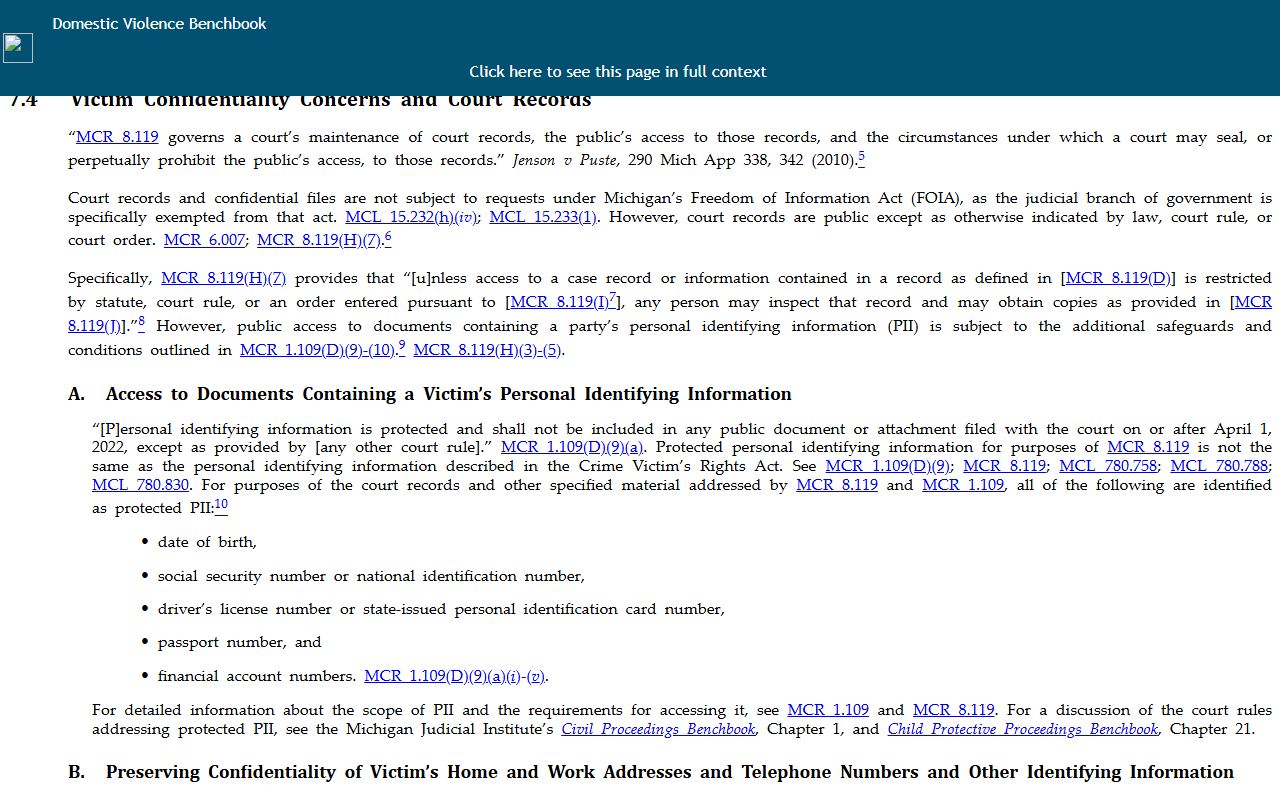
That guidance is why a Bay County criminal court records search may show a redacted address or a withheld name, even when the case itself stays open. The confidentiality carve-out protects victims without closing the whole file.
Key Statutes:
Michigan Court Rules § MCR 8.119 - defines court records and opens them to public inspection unless a file is restricted.
Michigan Court Rules § MCR 8.119(I) - lets a court seal or restrict a file by statute, court rule, or order.
Criminal Background Check Considerations
A casual portal lookup is not a background check. Employers, landlords, and licensing bodies that run formal screening must follow the federal Fair Credit Reporting Act, which sets rules on accuracy, notice, and dispute rights. A quick name search on the county portal carries none of those protections, and it can pull the wrong person when two names match.
Confirm any hit against the official file before you act on it. The certified court record is the version that counts.
Important: This site is a privately run resource and is not a consumer reporting agency under the FCRA, so its results cannot be used for credit, employment, tenant, or insurance decisions.
Restricted Bay County Criminal Records
Some criminal files are closed to the public. Juvenile matters are the clearest example. Consent-calendar and diversion proceedings are confidential and are not public record, and a youth who completes diversion may avoid an ordinary public record. Sealed adoption files and certain protected family matters follow the same closed-access rule.
Prior custody history has limits too. The Bay County Jail will not divulge a person's previous incarceration without proper authority. Active warrants are handled through separate channels rather than a public criminal-file search. When a record is restricted, the court does not release it just because someone asks, and a sealed or juvenile file stays out of reach even to a determined searcher.